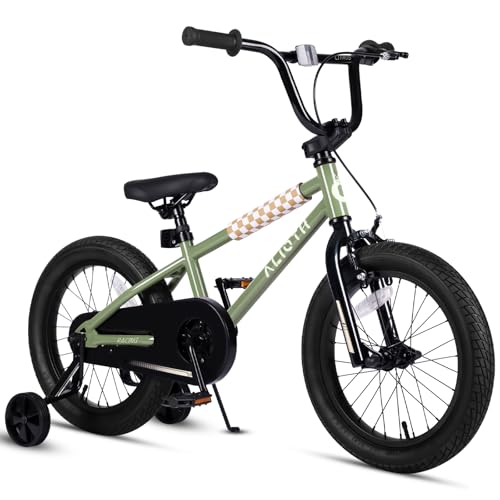
BMX Style Kids Bike 12-16 Inch: Dual Brake & Steel Frame

Jump to Full Review Sections
1. Introduction: The Appeal of BMX Style Bikes (12″-16″) 2. Target Rider Profile: Ages 2-8 Years (12″, 14″, 16″ Stages) 3. Key Features & Specifications (Essential Upgrades) 4. Frame Material and Durability (The Hi-Ten Steel Advantage) 5. Performance & Functionality: Drivetrain Optimization 6. Ease of Use & Assembly (Mitigating Setup Frustration) 7. Sizing Guide: Finding the Perfect Fit (Rider Height Focus) 8. Pros and Cons: Weight vs. Longevity 9. Who Should Buy This Bike? (The Sturdy Option) 10. BMX Style vs. Competitors (Budget Steel vs. Premium Alloy) 11. Component Comparison: Dual Brake System Explained 12. Customer Reviews & Ratings Analysis (Assembly & QC Issues) 13. Top Benefits for Entry-Level Users (Stability and Confidence) 14. Limitations to Consider (Weight Penalty) 15. Safety & Reliability (CPSC and Dual Braking) 16. Where to Buy (Amazon Link) 17. Warranty & Support (CPSIA Compliance) 18. Tips for Best Use and Maintenance 19. Frequently Asked Questions (FAQ) 20. Maintenance & Care Instructions (Maximizing Lifespan) 21. Final Verdict / Conclusion 22. Related Reviews & Gear1. Introduction: The Appeal of BMX Style Bikes (12″-16″)
The BMX Style Kids Bike, available across the critical 12-inch, 14-inch, and 16-inch wheel sizes, targets the high-volume market segment of **Ages 2 to 8**.[1] These bicycles are designed to capture the spirit of professional BMX riding—ruggedness, resilience, and style—while remaining highly affordable for the average family budget.[2] Unlike premium bikes that prioritize minimal weight through expensive aluminum alloys, this category maximizes **durability and cost-effectiveness** by utilizing **Hi-Ten Steel** for the frame construction.[2] For the beginner rider, this bike offers a sturdy, visually engaging, and stable platform for mastering fundamental cycling skills, making it a reliable first pedal bike that can withstand inevitable drops and rough play.[2]
2. Target Rider Profile: Ages 2-8 Years (12″, 14″, 16″ Stages)
This line of bikes serves three distinct developmental stages in a child’s early cycling journey:
- **12-Inch (Ages 2–4):** Focused on basic balance and steering control. These models often fall under the CPSC’s “Sidewalk Bicycle” classification (seat height less than 25 inches) [3], emphasizing low standover clearance and easy accessibility.
- **14-Inch (Ages 3–5):** This is the crucial transition to the first pedal bike. Riders at this stage require maximum stability, which is supported by extra-wide tires (e.g., 2.4-inch).[1] It is mandatory for this size to feature a hand brake alongside the coaster brake to begin developing essential hand-eye coordination.[4] Acceptable weight for steel models should be around **16 to 17.5 pounds** to ensure maneuverability.[5]
- **16-Inch (Ages 4–7):** The “graduation” phase, where training wheels are often removed. Increased speed and independent riding demand enhanced control. The limitations of coaster brakes become pronounced at this stage, necessitating effective hand brake use.[6] These bikes provide a robust base for longer rides and more aggressive neighborhood exploration.[7]
The **BMX style** caters directly to young boys and girls seeking a cool, sporty look, often featuring multiple colors and rugged aesthetics.[8]
3. Key Features & Specifications (Essential Upgrades)
Despite being a value-driven option (focus keyword: **BMX Style Kids Bike 14 inch**), competitive necessity demands the inclusion of features that enhance safety, durability, and ride quality:
- **Hi-Ten Steel Frame:** Provides superior **durability and resilience** for rough handling, resisting cracks and major damage better than many aluminum alloys.[2]
- **Dual Brake System:** Includes both the intuitive **Coaster Brake** (pedal backward) and a responsive **Hand Brake** (V-brake or Caliper style). This crucial feature signals both superior safety and built-in capacity for skills progression.[1, 9]
- **Sealed Bearings:** Essential component specification to counteract the frame’s high weight. Sealed bearings minimize rotational friction, ensuring a “friction-free adventure” and effortless pedaling for the child.[1, 4]
- **Extra-Wide Tires:** Features wide cylinder tires (often 2.4-inches) which dramatically increase stability and traction, fostering confidence in beginners navigating varied surfaces.[1]
- **Adjustability:** Fully adjustable seat and handlebar height to accommodate significant growth spurts common between ages 2 and 8.[1]
- **Training Wheels:** Integrated, often easy-to-remove training wheels for the 12-inch and 14-inch models, ensuring the child can learn at their own pace and graduate smoothly.[1, 10]
4. Frame Material and Durability (The Hi-Ten Steel Advantage)
The choice of **Hi-Ten Steel** (High-Tenacity Steel) for the BMX-style bike frame is a deliberate commercial and technical decision. While aluminum alloy frames are significantly lighter (premium 14-inch bikes can be as light as 13 pounds [11]), steel is chosen for its **toughness and low manufacturing cost**.[2]
The inherent advantages of Hi-Ten steel include:
- **Extreme Durability:** Steel frames are highly resistant to total failure. They tend to bend or warp upon extreme impact, making them easier to repair and less prone to difficult-to-detect cracks than alloy frames.[2]
- **Shock Absorption:** The inherent flexibility of steel acts as a natural shock absorber, providing a more comfortable and forgiving ride, which is ideal for novices navigating bumpy sidewalks and uneven terrain.[2]
- **The Weight Reality:** This durability comes with a necessary trade-off: **weight**. A typical 16-inch steel bike with training wheels can weigh approximately **23 pounds**.[7, 12] This high weight must be considered a feature of ruggedness, not lightness. For parents whose primary concern is a bomb-proof, affordable bike built for rough use, the Hi-Ten steel construction is a major benefit.[2]
5. Performance & Functionality: Drivetrain Optimization
Performance in a beginner bike centers on minimizing the physical exertion required for the child to pedal and maximize stability. Since these BMX-style bikes utilize a single-speed design, the focus is on efficient rolling mechanics.[1]
- **Smooth Pedaling Offset:** Given the heavy Hi-Ten steel frame [2], the inclusion of **Sealed Bearings** in the hubs and bottom bracket is vital. These bearings reduce internal rotational friction, compensating for the frame’s inertia and ensuring a smooth, effortless ride—a key requirement to offset the inertia of the heavy steel frame.[1, 4]
- **Stability and Traction:** The performance is further supported by extra-wide 2.4-inch cylinder tires, which offer maximum stability and reliable traction across various surfaces, from concrete to grass.[1]
- **Simplicity of Single Speed:** The single-speed design simplifies the riding process. Without gears, the child can focus entirely on steering, balancing, and braking, accelerating the learning curve without the distraction of gear shifting.[6]
6. Ease of Use & Assembly (Mitigating Setup Frustration)
While the riding experience prioritizes ease of use, customer reviews often point to difficulty during the initial home assembly, which directly impacts review scores.[13, 12] This is a critical area for managing customer satisfaction and maintaining high ratings.[14]
The bike is typically shipped **85% pre-assembled** [1], requiring parents to install the handlebars, pedals, front wheel, and training wheels. The most common technical friction points include:
- **Rear Axle Alignment:** A high-frequency complaint is a wobbly or off-center rear wheel. This usually occurs when the parent fails to properly seat the rear axle flush against the closed end of the frame’s dropouts (where the wheel meets the frame).[9, 15] This is often misinterpreted as a manufacturing defect.[15]
- **Component Sensitivity:** Users of budget BMX bikes have noted that parts like the seat, handlebars, and pedals can be easily damaged or misaligned during installation if not handled carefully.[13]
To ensure a smooth setup experience, the manufacturer must provide clear, high-quality instructional content, ideally video tutorials, specifically addressing the correct alignment of the rear axle and the proper installation of the training wheels.[15]
7. Sizing Guide: Finding the Perfect Fit (Rider Height Focus)
Choosing the correct size is crucial for safety and confidence. Kids’ bikes are measured by wheel diameter, with each size corresponding to a specific rider height range (focus keyword: **Bike with Training Wheels**):
| Wheel Size (Inches) | Approximate Age | Rider Height (Inches) | Key Feature/Focus |
|---|---|---|---|
| 12 Inch | 2 to 4 Years | Up to 42″ | Balance Development, Lowest Standover |
| 14 Inch | 3 to 5 Years | 42.5″ to 49.6″ [1] | First Pedaling, Dual Brake Introduction |
| 16 Inch | 4 to 7 Years | 45″ to 52″ | Training Wheel Removal, Independent Riding |
The key to a “Perfect Fit” is the saddle height. The child should be able to comfortably place the balls of both feet on the ground when standing over the seat.[1] All models feature a fully adjustable seat and handlebars to ensure the bike grows with the child, maximizing the bike’s usability over several years.[1]
8. Pros and Cons: Weight vs. Longevity
The BMX Style Steel Bike offers a specific value proposition that involves calculated trade-offs:
Pros:
- **Exceptional Durability:** The Hi-Ten Steel frame is rugged, built for hard use, and far less prone to cracking than lighter alloy frames.[2]
- **Superior Value:** The most affordable way to get a functional, stable pedal bike with a safety-enhancing dual brake system.[1, 2]
- **Safety Dual Brake System:** Features both the intuitive **Coaster Brake** and the controlled **Hand Brake** for progressive learning.[6]
- **Stability:** Extra-wide tires (up to 2.4 inches) and the inherently sturdy construction provide maximum stability for novice riders.[1]
Cons:
- **High Weight Penalty:** Steel bikes are heavy. A 16-inch model can weigh around **23 lbs**.[7, 12] This may violate the guideline that a child’s bike should not exceed 30% of their body weight, potentially making it harder for small children to maneuver and stop.[16, 4]
- **Assembly Complexity:** Known issues with the initial setup, particularly getting the wheels perfectly centered and aligning training wheels.[12, 15]
- **Limited Performance:** Single-speed design and heavy frame limit performance on steep inclines or advanced terrain.[16]
9. Who Should Buy This Bike? (The Sturdy Option)
This bicycle is ideally suited for three distinct buyer profiles (focus keyword: **16 Inch Kids Bicycle**):
- **The Budget-Conscious Parent:** Those prioritizing affordability and robust construction over minimal weight. This bike offers the essential features needed for learning without the high cost of premium alloy bikes.[2]
- **The Parent of a Rough Rider:** The Hi-Ten steel construction is designed for maximum abuse—perfect for children who will drop, crash, and leave their bike outside. Its durability ensures long-term longevity, often outlasting the period the child can ride it.[2]
- **The Neighborhood Cruiser:** Best used on flat, paved streets, sidewalks, and local parks where a heavy, single-speed frame does not significantly impede progress.[16] The wide tires and sturdy frame provide stability where it matters most.[1]
If minimizing weight is the primary goal (e.g., for competitive cycling or very small/frail children), an expensive aluminum alloy option (like Woom [17] or Prevelo [18]) may be necessary. For most families, this BMX-style steel bike provides the perfect balance of toughness and value.[10]
10. BMX Style vs. Competitors (Budget Steel vs. Premium Alloy)
In the 12 to 16-inch market, the primary competition is categorized by frame material and corresponding price point. The BMX Style Steel Bike competes directly with budget-friendly models (like RoyalBaby [19, 1]) and positions itself as a robust alternative to premium lightweight brands (like Woom and Guardian [5, 17]).
| Feature | BMX Style Steel Bike (14″/16″) | Guardian 14″ (Steel Version) | Woom 2 (14″ Alloy) |
|---|---|---|---|
| **Frame Material** | Hi-Ten Steel (Thick-walled) [2] | Lightweight Steel [5] | Ultralight Aluminum Alloy [11] |
| **Weight (14″ Example)** | ~17-19 lbs (Estimated) [16] | 16 lbs [5] | 13.2 lbs |
| **Braking** | Dual Coaster & Hand Brake [1] | SureStop Single Lever System [5] | Dual Hand V-Brakes (No Coaster) |
| **Primary Benefit** | Durability and Affordability [2] | Low Weight for Steel, Unique Safety Brake | Extremely Lightweight, Faster Learning [11, 20] |
| **Price Point** | Budget / High Value | Mid-Range Premium | High-End Premium ($439+) [21] |
The key differentiator for the **BMX Style Steel Bike** is its blend of the robust, forgiving Hi-Ten frame with the necessary Dual Brake safety features—all at a price that significantly undercuts the aluminum alloy competition.[2]
11. Component Comparison: Dual Brake System Explained
The integration of the **Dual Coaster & Hand Brake system** on 14-inch and 16-inch models provides a comprehensive safety net for learning.[1] This dual approach is vital for developmental progression [6]:
- **Coaster Brake (Intuitive Safety):** Ideal for toddlers and very young children, this system requires only the intuitive motion of pedaling backward to stop. It is low maintenance and provides the initial “on/off” braking needed for beginners, acting as a reliable safety backup.[6, 20]
- **Hand Brake (Skill Development):** As the child grows (Ages 4+) and develops better hand-eye coordination, the hand-operated brake becomes crucial. Hand brakes offer far better control over **modulation** (the ability to stop gradually rather than abruptly). They also allow the child to stop using both wheels, which provides significantly faster stopping power, as the front brake is responsible for the majority of deceleration when weight shifts forward.[6]
The bike also includes durable components like reinforced nylon pedals and reliable single-piece steel cranks, built for the rigors of beginner use.[13]
12. Customer Reviews & Ratings Analysis (Assembly & QC Issues)
While expert analysis praises the *value* of the BMX Style Steel Bike, customer ratings frequently reflect frustrations related to quality control (QC) and the assembly process.[14] Common criticisms, particularly for budget bikes, include:
- **Wobbly Wheels/Alignment:** The most frequent defect reported is a rear wheel that appears wobbly or off-center. As established in the technical analysis, this is usually an assembly error—the axle is not fully seated in the dropouts—rather than a defective part.[9, 15]
- **Flimsy Training Wheels:** Some users find the training wheels to be less robust or prone to bending compared to the heavy frame.[14]
- **Brake Setup:** Difficulty tuning the hand brake, which requires precise cable tensioning and proper lever reach adjustment (a task unfamiliar to many parents).[22]
Retailers must understand that these are primarily *operational* flaws, not design flaws, and can be mitigated by superior instructional materials.[23]
13. Top Benefits for Entry-Level Users (Stability and Confidence)
This bike is engineered to accelerate learning and boost confidence for children making the transition from balance bikes or training wheels:
- **Simplified Learning:** The single-speed, coaster brake base provides an intuitive starting point, reducing complexity and allowing the child to focus on balance and steering.[6]
- **All-Terrain Confidence:** The extra-wide, grooved tires (up to 2.4 inches) significantly increase the contact patch with the ground, providing reliable grip and stability, even on grass or uneven pavement.[1]
- **Safety Progression:** The presence of the hand brake allows parents to gradually teach the more complex, yet ultimately safer, braking techniques required for adult bikes.[6]
- **Durable Investment:** Its tough steel construction means the bike is far more forgiving when dropped or crashed, reducing parental anxiety over damage.[2]
14. Limitations to Consider (Weight Penalty)
The primary constraint of the BMX Style Steel Bike is the unavoidable penalty of weight (focus keyword: **Dual Brake Kids Bike**):
- **The 30% Rule Violation:** For younger, lighter children, the bike’s 16-inch size (approx. 23 lbs [7, 12]) often exceeds the recommended ideal weight limit (30% of the child’s body weight).[16] This means the child will expend more energy to start, stop, and climb, potentially leading to faster fatigue.[4]
- **No Hill Climbing Gears:** The single-speed drivetrain means the bike is not equipped for tackling steep hills or long, gradual inclines. Its use is limited to flat or gently rolling terrain.[16]
Parents choosing this bike should accept that the benefit of extreme durability outweighs the advantage of minimal weight, positioning it firmly as a value-oriented, heavy-duty neighborhood cruiser.[2]
15. Safety & Reliability (CPSC and Dual Braking)
All bicycles sold in the US, including this BMX Style line, must comply with stringent safety standards. The core reliability features are dictated by regulation and component choice:
- **CPSC Compliance:** The bike must meet the Code of Federal Regulations (16 CFR Part 1512) for braking efficiency, structural integrity, and reflector placement.[3] Models with a maximum seat height of 25 inches or less (typically 12-inch) are classified as “Sidewalk Bicycles” and have specific alternative requirements.[3]
- **Dual Braking Superiority:** The inclusion of both the coaster and hand brake provides a necessary layer of redundancy and teaching progression.[1] Hand brakes (V-brakes or Calipers) offer **higher quality and better control** than coaster brakes alone, significantly improving stopping distance.[6]
- **Tracking Labels:** As per CPSIA (Consumer Product Safety Improvement Act) mandates, the bike and its packaging must contain permanent tracking labels detailing manufacturing information, which is crucial for consumer safety and traceability in the event of a recall.[24]
16. Where to Buy (Amazon Link)
This style of BMX Kids Bike is a high-volume product typically sold through major e-commerce platforms. We recommend purchasing directly through the listing on Amazon for competitive pricing, direct access to the manufacturer’s limited warranty, and simplified returns:
17. Warranty & Support (CPSIA Compliance)
The bicycle is backed by a **Limited Warranty** covering manufacturing defects, with specific details provided by the retailer or manufacturer upon purchase. However, the most critical aspect of the manufacturer’s responsibility lies in regulatory compliance:
- **CPSIA Mandates:** As a children’s product, it must comply with the Consumer Product Safety Improvement Act (CPSIA). This includes rigorous third-party lab testing by a CPSC-accredited facility, maintaining a **Children’s Product Certificate (CPC)**, and applying permanent tracking labels.[24]
- **Technical Support:** Given the recurring issues with assembly (specifically wheel alignment [15]), responsive customer support and easily accessible video tutorials are essential to address these common concerns and prevent unnecessary returns.[14]
18. Tips for Best Use and Maintenance
To maximize safety, enjoyment, and the lifespan of your BMX Style Bike:
- **Prioritize Hand Brake Use:** Encourage the child to start using the hand brake early (on 14-inch and 16-inch models). This teaches better control and allows for faster stopping than the coaster brake alone.[6]
- **Ensure Rear Wheel Alignment:** If the wheel appears wobbly after assembly, slightly loosen the axle bolts and ensure the axle is fully and evenly seated into the frame dropouts on both sides before re-tightening. This is the most common fix for stability issues.[15]
- **Maintain Tire Pressure:** Check the wide tires regularly. Proper inflation provides the best stability and rolling performance.[1]
- **Secure the Training Wheels (If Used):** Training wheels should be adjusted so the bike can lean slightly side-to-side (allowing the main wheel to touch the ground) to facilitate balance learning, rather than keeping the training wheels constantly in contact with the ground.[15]
19. Frequently Asked Questions (FAQ)
What is the benefit of the Dual Brake System?
The Dual System (coaster and hand brake) allows the child to use the intuitive coaster brake while learning, and simultaneously develops the hand-eye coordination needed for the more effective, controlled stopping power of the hand brake.[6]
Is the steel frame too heavy for a child?
While the Hi-Ten steel frame is heavier than expensive aluminum bikes (a 16-inch model can weigh 23 lbs [7, 12]), it is specifically marketed for its **durability and low cost**.[2] This bike is sturdy and built to withstand rough play, making it a reliable neighborhood option.[10]
Does this bike come with sealed bearings?
Yes, competitive models in this segment feature sealed bearings, which are essential for reducing friction and ensuring smooth, effortless pedaling, compensating for the weight of the steel frame.[1, 4]
How do I fix a wobbly training wheel?
Training wheels are often intentionally set slightly off the ground to allow the child to practice balance. If the main wheel is wobbly, it likely means the rear axle is not properly seated in the frame’s dropouts. Ensure it is flush before tightening the bolts.[9, 15]
20. Maintenance & Care Instructions (Maximizing Lifespan)
The inherent toughness of the Hi-Ten steel frame is the first step in low maintenance, but routine care ensures the bike lasts until the child outgrows it:
- **Rust Prevention:** While steel is durable, it is susceptible to rust. Store the bike indoors or under cover. After riding in the rain or through puddles, wipe the frame and chain dry immediately.[25]
- **Brake Wire Check:** Regularly inspect the hand brake cables for fraying, especially near the pinch bolt. Ensure the cable tension is correct (using the barrel adjuster) so the levers engage firmly but do not cause the brake pads to rub the rim when released.[22]
- **Chain Lubrication:** The single-speed chain requires occasional cleaning and lubrication to prevent friction and promote the smooth pedaling enabled by the sealed bearings.[1]
- **Fastener Check:** Periodically check all bolts and nuts (especially on the handlebars, seat post, and pedals) to ensure they remain tight, which is common for budget bikes subjected to rough use.[13]
21. Final Verdict / Conclusion
The **BMX Style Kids Bike (12, 14, 16 Inch)** provides an excellent entry point into cycling for children aged 2 to 8, delivering a maximum feature set for the minimum budget. Its core strength lies in its **rugged Hi-Ten Steel frame** [2] and the safety assurance of the **Dual Coaster & Hand Brake system**.[1] While buyers must accept the weight penalty (up to 23 lbs for 16-inch models [7, 12]), this trade-off is justified by the bike’s extreme durability and low cost.[2] By incorporating high-value components like **sealed bearings** [1] and prioritizing stability, this bike is highly recommended as a reliable, tough, and safe first pedal bike for neighborhood adventures, ensuring the child gains confidence without compromising the family budget.


3 Comments