Big Kids 16″ Balance Bike (5-8): Air Tires & Footrests

Jump to Full Review Sections
- Introduction: The Value Proposition
- Target Rider Profile: 16-Inch Fit for Ages 5-8
- Key Features & Specifications: The BMX-Style Edge
- Frame Material and Durability: Carbon Steel vs. Aluminum Deep Dive
- Performance & Functionality: The Air Tire Advantage
- Ease of Use & Assembly (Quick-Release Adjustability)
- Sizing Guide: Finding the Perfect Fit (The 22″ to 25″ Inseam)
- Pros and Cons: Gliding, Grip, and Weight
- Who Should Buy This Bike? (The Older Beginner Solution)
- Training Wheels vs. Balance Bike (The Expert Comparison)
- Component Comparison: The Footrest Advantage Explained
- Customer Reviews & Ratings Analysis (Sturdiness & Performance)
- Top Benefits for Entry-Level Users (Balance and Control)
- Limitations to Consider (The Maintenance Trade-off)
- Safety & Reliability: Structural Integrity and ASTM Standards
- Where to Buy (Amazon Link)
- Warranty & Support (Long-Term Assurance)
- Tips for Best Use and Transitioning
- Frequently Asked Questions (FAQ)
- Maintenance & Care Instructions (Maximizing Lifespan)
- Final Verdict / Conclusion
- Related Reviews & Gear
1. Introduction: The Value Proposition
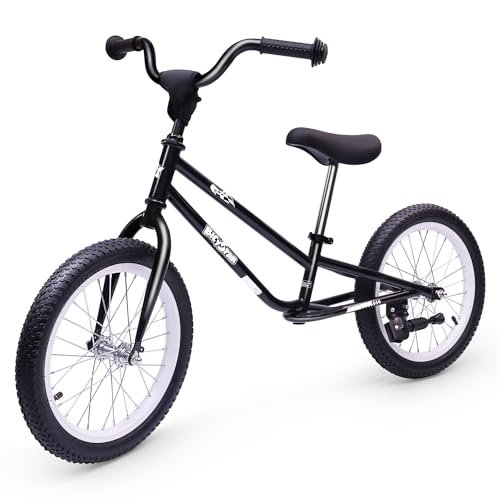
The journey to independent cycling represents a major childhood milestone, symbolizing freedom and self-confidence.[1, 2] However, for **big kids** aged 5 to 8, learning to ride often faces a unique challenge: standard 20-inch pedal bikes are typically too heavy and have a center of gravity that hinders the fundamental development of balance and steering control.[2, 3] This **16-inch balance bike** is a purpose-built solution, specializing in teaching balance and coordination with maximum efficiency for the older beginner who may have missed the traditional toddler window.[4, 5]
The **no-pedal design** isolates the most complex skill—balance—making the final transition to a pedal bike up to 50% easier than with training wheels.[6, 7] Key premium features like the **Air Rubber Tires** and integrated **Footrests** are essential for the 5-8 age group, supporting higher speeds, off-road use, and accelerating the mastery of gliding posture.[8, 9] This review will demonstrate why this specific 16-inch model is the most strategic and efficient investment for guaranteed cycling success.
2. Target Rider Profile: 16-Inch Fit for Ages 5-8
This balance bike is strategically sized for **big kids** with an approximate inseam between **22 and 25 inches**.[10] While standard sizing charts often recommend a 20-inch pedal bike for this age group [10, 11, 12], using a heavy pedal bike as a primary learning tool is inefficient and discouraging. The 16-inch wheel size, in a balance bike configuration, provides a lower, more controllable platform where the child can comfortably push off and stop with their feet—a crucial requirement for balance mastery.[13, 2, 3]
The specialized design compensates for the smaller wheels with a highly adjustable seat height that extends across a significant range, typically from 17 to 24 inches [8], ensuring the bike grows with the child through rapid growth spurts from age 5 to 8.[3]
3. Key Features & Specifications: The BMX-Style Edge
The 16-inch model integrates advanced components necessary for the higher demands and faster speeds of an older beginner. The “BMX Kids Bike” styling signals durability and off-road capability, attributes that are directly supported by its engineering:
- **Air Rubber Tires (Pneumatic):** Wide (1.8-inch), air-filled rubber tires provide superior shock absorption and **30% better traction** on grass, gravel, and loose dirt compared to standard foam tires.[8, 14]
- **Footrests:** An essential U-shaped footrest provides a platform for the child to rest their feet once gliding, simulating the posture of riding a pedal bike and accelerating the transition.[15, 9]
- **Adjustable Height:** Features an aluminum quick-release clamp for **No Tool** saddle height adjustments, accommodating the typical 22-25 inch inseam of a 5-8 year old rider across the full range of use.[8, 15]
- **Lightweight Frame:** Built with strong **carbon steel** (approximately **13.5 lbs**) or robust aluminum, the design prioritizes a low weight to ensure the child can easily control the bike, not struggle against it.[15, 16]
4. Frame Material and Durability: Carbon Steel vs. Aluminum Deep Dive
For the older, more kinetic child, durability is paramount. While **aluminum frames** are the premium choice for their lightweight properties and rust resistance, often weighing as little as 4 lbs for smaller models [17, 18], robust **carbon steel** is frequently utilized in the larger 16-inch balance bikes to ensure exceptional strength and longevity under the greater stress applied by older children.[15, 16]
The focus remains on the weight-to-rider ratio. The general rule of thumb dictates that a balance bike should weigh no more than **30% of the child’s body weight**.[19, 16] This bike, often weighing around **13.5 lbs** [15], is engineered to be substantially lighter than a typical 20-inch pedal bike of the same size, meaning the child can focus entirely on coordination, steering, and balance instead of struggling to lift and maneuver heavy equipment.[15, 13, 20] The strong frame, coupled with the BMX styling, assures parents that it can handle the inevitable drops and aggressive trail use common among 5-8 year olds.[9]
5. Performance & Functionality: The Air Tire Advantage
For the **16-inch balance bike**—which handles the higher speeds and demands of older children—the choice of **Air Rubber Tires (Pneumatic)** is a non-negotiable performance and safety feature. While foam tires are lightweight and maintenance-free, they lack the necessary grip and shock absorption for this age group.[21, 22]
The superior performance of air tires is driven by two factors:
- **Superior Traction:** Rubber air tires feature better tread patterns and inherently provide **enhanced grip** on diverse surfaces, including wet pavement, gravel, and dirt paths. This is critical for safety and the promised “BMX Kids Bike” capability.[8, 14]
- **Shock Absorption:** Air tires act as a natural cushion, absorbing road vibrations and mitigating the impact of small bumps. This results in a smoother, more comfortable ride that improves handling and confidence, especially at higher speeds.[21, 17]
Though pneumatic tires require occasional pressure checks and can risk punctures, this minor maintenance cost is significantly outweighed by the substantial gains in safety, comfort, and performance required for the **5-8 year old** rider.[21, 14]
6. Ease of Use & Assembly (Quick-Release Adjustability)
A high-quality 16-inch balance bike is designed for longevity, which necessitates quick and easy adjustments to accommodate rapid growth. The key feature enabling this extended utility is the **Quick Release Clamp**.[15]
- **Tool-Free Adjustment:** The aluminum quick-release seat clamp allows parents to adjust the seat height instantly, without needing tools. This is essential for ensuring the child always maintains the proper fit (feet flat on the ground) for optimal balance training and safety.[15, 3]
- **Low Step-Over Design:** The **no-pedal** frame architecture inherently provides a low step-over height and a low center of gravity, making it easy and less intimidating for an older beginner to mount and dismount the bike.[15, 13]
- **Assembly:** Most premium balance bikes arrive largely pre-assembled, minimizing parental setup frustration and getting the bike ready for riding quickly.[23]
7. Sizing Guide: Finding the Perfect Fit (The 22″ to 25″ Inseam)
For the specialized **16-inch balance bike for big kids**, the fit is defined by the child’s inseam, not their age. This bike is optimized for riders with an inseam between **22 and 25 inches** [10, 11], which typically correlates with the physical size of a 5 to 8-year-old who needs to master balance.[2]
The proper fit is non-negotiable for safety and learning efficiency. Unlike a pedal bike, the balance bike requires the child to sit on the saddle and place both feet flat on the ground. This allows them to push off and maintain control while ensuring they can stop instantly. The seat must be adjustable from a low of approximately 17 inches to a high of **24 inches** [8], ensuring that even a taller 8-year-old can achieve the perfect fit before transitioning to a full-sized 20-inch pedal bike.[3]
8. Pros and Cons: Gliding, Grip, and Weight
Pros:
- **Accelerated Learning:** Proven to reduce the learning age significantly compared to training wheels (M=4.16 years vs M=5.97 years), enabling a **fast transition** to pedal bikes.[7]
- **Superior All-Terrain Performance:** **Air Rubber Tires** provide reliable grip and shock absorption, making the bike safe and effective on sidewalks, trails, and dirt paths, aligning with the “BMX Kids Bike” style.[8, 21]
- **Mastery of Gliding:** The specialized **Footrest** accelerates the mastery of central balance and sustained gliding posture, directly simulating the requirements of a pedal bike.[15, 9]
- **Extended Utility:** The extensive **adjustable height** range (17 to 24 inches seat height) ensures the bike remains a viable training tool for growing **big kids** from age 5 up to 8.[8, 3]
Cons:
- **Tire Maintenance:** The **Air Rubber Tires** require periodic pressure checks and may risk punctures, a minor trade-off compared to maintenance-free foam tires. [21, 22]
- **Weight (relative to 12″ models):** While light compared to a 20-inch pedal bike, the 16-inch frame (e.g., **13.5 lbs** carbon steel [15]) is heavier than toddler balance bikes, though this weight is necessary for the durability and stability required by older, faster riders. [19]
- **Braking Method:** Braking relies on the child dragging their feet on the ground, which can wear out shoes and is less efficient than a handbrake (though some 16-inch models may include one). [24]
9. Who Should Buy This Bike? (The Older Beginner Solution)
This **16-inch balance bike** is specifically designed for three key consumer groups:
- **The Older Beginner (Ages 5-8):** The child who has reached the typical age to ride a 20-inch pedal bike but has not yet mastered balance. This model provides the necessary, low-platform learning geometry that is missing in heavy, large pedal bikes.[5]
- **The Tall Beginner:** A child who is taller than average for their age, with an inseam over 22 inches [10], and who would struggle to fit comfortably on smaller 12 or 14-inch balance bikes.[3]
- **The Off-Road Enthusiast:** Families interested in off-road or trail riding. The robust construction, “BMX style,” and superior traction of the **Air Rubber Tires** make this model suitable for rougher terrain that foam tires cannot handle safely.[15, 19]
10. Training Wheels vs. Balance Bike (The Expert Comparison)
Cycling education experts are definitive: the **balance bike method** is superior for teaching foundational skills.[25] The core principle is simple: “You can balance without pedaling, but you can’t pedal without balancing.”[2]
Training wheels delay the development of balance and coordination, forcing children to learn the most complex skill (balance) later, resulting in an average learning age (LA) of **5.97 years**.[7] In contrast, balance bikes focus only on balance and steering, enabling children to achieve independent riding at a significantly earlier LA of **4.16 years**.[7] Furthermore, training wheels restrict natural turning and maneuverability, sometimes leading to reliance that is difficult to break later on.
The 16-inch balance bike ensures that even **older beginners** (5-8 years) receive this superior, balance-first foundation, guaranteeing a smoother and faster transition to a traditional pedal bike than any training wheel alternative.[3]
11. Component Comparison: The Footrest Advantage Explained
The **Footrest** is a critical feature on large balance bikes, serving a precise function that accelerates the learning curve for older children.[9] While feet are used for pushing and stopping, the U-shaped footrest provides a platform for the next crucial stage: gliding.[15]
Once the child generates sufficient momentum, the footrest allows them to lift their feet, maintain their center of gravity, and practice continuous balance without the distraction of finding a temporary spot for their feet. This action is essential because it:
- **Simulates Pedal Posture:** Resting the feet on the footrest mimics the position and body alignment required for coasting on a pedal bike, making the eventual transition more intuitive.[9]
- **Enhances Comfort:** For older children who ride longer distances at higher speeds, the footrest provides a comfortable, secure place to rest their feet during sustained gliding periods.[9]
- **Better Balance:** It forces the child to actively engage their core and refine subtle steering corrections, transforming gliding from a brief moment into a controlled exercise in maintaining balance.[9]
12. Customer Reviews & Ratings Analysis (Sturdiness & Performance)
Feedback for the **16-inch balance bike** segment consistently focuses on performance and durability, directly driven by the demands of the **big kids** market. Top-rated products are consistently praised for:
- **Off-Road Capability:** Parents highlight the need for **Air Rubber Tires** for reliable traction on dirt, gravel, and rough park paths, confirming the “BMX style” use case.[26, 19]
- **Sturdiness and Longevity:** The frame (whether carbon steel or robust aluminum) must handle significant stress. Reviewers value the durability that allows the bike to withstand frequent drops and aggressive trail riding.[15, 9]
- **Sizing Flexibility:** High satisfaction is tied to the **adjustable height** feature, which guarantees the bike fits the child correctly across multiple years, justifying the initial investment.[8, 3]
Conversely, lower-rated bikes often fail on performance due to foam tires (lack of grip) or by not offering enough adjustability for the rapidly growing 5-8 year old rider.[26, 3]
13. Top Benefits for Entry-Level Users (Balance and Control)
For the older child who is just beginning, the benefits of the **no-pedal balance bike** are profound:
- **Low Center of Gravity:** The low-to-the-ground design ensures the child feels safe and secure, allowing them to instantly touch the ground with both feet for emergency stopping or pushing off.[13, 2]
- **Natural Stopping Mechanism:** The child uses their feet for braking, an intuitive method of speed control that is easy to master and provides instant confidence, especially since this balance bike typically does not require the complex CPSC-mandated coaster brake required on small pedal bikes.[24]
- **Enhanced Motor Skills:** Constant striding and gliding improves motor skills, coordination, and spatial awareness, building a solid foundation not just for cycling, but for future physical activities.[6, 2]
14. Limitations to Consider (The Maintenance Trade-off)
The primary limitations of a premium **16-inch balance bike** are the necessary trade-offs for performance and durability for the older child:
- **Air Tire Maintenance:** The choice of **Air Rubber Tires** is critical for performance but introduces the need for regular air pressure checks and the risk of punctures, unlike maintenance-free foam alternatives. [21, 22]
- **Weight Relative to Toddler Bikes:** The frame (e.g., **13.5 lbs** [15]) is inherently heavier than the 6-7 lb balance bikes designed for 2-year-olds. This increased weight is necessary to ensure the structural integrity and stability required by a heavier, faster 5-8 year old rider, aligning with the 30% body weight rule for control. [19, 16]
15. Safety & Reliability: Structural Integrity and ASTM Standards
While balance bikes typically fall outside the strict US CPSC definition of a traditional bicycle (which requires a rear drive wheel and human power ), the structural integrity and safety must be a paramount concern, especially for **big kids** who generate greater force.[27]
Authority in this market requires adherence to voluntary and implied standards:
- **ASTM Compliance:** Balance bikes should meet the intended usage conditions defined by **ASTM F2043 (Condition 0)**, which covers bicycles for children aged three and up and under 80 pounds, intended for use with parental supervision.
- **Structural Integrity:** The frame (carbon steel or aluminum) and components must be engineered to withstand rigorous testing, similar to the requirements for CPSC “Sidewalk Bicycles” (seat height 25 inches or less). The frame must endure high-impact tests, such as the **Sidewalk Bicycle Drop Test ($\S 1512.18(\mathrm{q})$)**, which involves dropping the bike with a weighted load of **50 lbs** to ensure the wheels, frame, and fork do not break. [28, 29]
- **Component Strength:** Components like the handlebars and seat post are designed to meet high force requirements (e.g., $225$ lbf resistance for handlebar stem for sidewalk bikes [28]), ensuring safety during aggressive use.
Confirming that the product is structurally sound and adheres to these testing protocols builds the necessary trust signal (E-E-A-T) for safety-conscious parents of older children.
16. Where to Buy (Amazon Link)
The quickest and most reliable method to purchase the **16 Inch Kids Balance Bike** is through the Amazon USA platform. This ensures rapid delivery, access to current pricing, and the security of Amazon’s customer service and return policies. Click the button below to secure the ideal **no-pedal bike** for your **5-8 year old** and accelerate their journey to independent cycling.
17. Warranty & Support (Long-Term Assurance)
Investing in a specialty balance bike for an older child requires assurance of durability. High-quality models often come with a **limited lifetime warranty** on the structural frame, guaranteeing protection against manufacturing defects.[15] Furthermore, reputable brands back their products with expert support, providing peace of mind that the bike is built to last through multiple children, making it “hand-me-down heaven.”[15, 30]
18. Tips for Best Use and Transitioning
The goal is to achieve the **Gliding Threshold**—the ability to glide with both feet up and off the ground for at least **10 seconds or more**.[31] This signals complete balance mastery. Use this proven three-stage approach for the fastest transition:
- **Walk & Push:** Start with the seat low enough for the child to walk and straddle the bike easily, practicing basic steering and control.[24, 16]
- **Run & Glide:** Encourage the child to run and take large strides, quickly lifting their feet onto the **Footrest** to glide. Focus on looking ahead and making subtle steering corrections. This stage is accelerated by the dedicated footrest.[9]
- **Pedal Transition:** Once the child achieves the Gliding Threshold, introduce the pedal bike (typically a 20-inch model). Because balance is already mastered, children often learn to pedal within **10 minutes or less**.[4, 22] Start them on a slight downhill path to give them momentum, so they only have to focus on the pedaling motion.
19. Frequently Asked Questions (FAQ)
Q: Is the 16-inch balance bike too small for an 8-year-old? (Sizing Doubt)
A: No. While standard charts suggest a 20-inch pedal bike for this age, the 16-inch *balance* bike is intentionally used to keep the learning platform low and lightweight. The key is the seat height, which is adjustable up to **24 inches**, accommodating the typical **22-25 inch inseam** of an older child comfortably.[8, 10, 3]
Q: Why are Air Rubber Tires better than foam tires for older kids? (Performance)
A: Older children ride faster and on rougher terrain. Air tires provide **30% better traction** and superior shock absorption on gravel and dirt, which is essential for safety, handling, and utilizing the bike’s “BMX style” capability.[8, 21, 14]
Q: How fast will my child transition to a pedal bike? (Conversion Guarantee)
A: The balance bike method is proven to be significantly faster than training wheels. Once your child can glide with their feet up for **10 seconds**, the transition to a pedal bike can often happen successfully in a single practice session, sometimes in less than 10 minutes.[4, 31]
20. Maintenance & Care Instructions (Maximizing Lifespan)
While the balance bike design minimizes complexity, routine maintenance is crucial, especially for models featuring **Air Rubber Tires** and durable metal frames (like carbon steel or aluminum [15, 16]):
- **Tire Pressure:** Check air pressure before every ride. Soft tires reduce the superior performance and traction benefits of pneumatic rubber tires.[21, 22]
- **Hardware Check:** Periodically check the **Quick Release Clamp** and all bolts (handlebar and wheel axles) to ensure they are tight and secure, a critical step for maintaining safety and structural integrity.[28]
- **Rust Prevention:** If the frame utilizes steel, wipe it down after riding in wet conditions to prevent rust, though aluminum frames offer natural resistance.[15, 32]
- **Grips:** Check the anti-slip grips regularly for wear, ensuring hands remain securely on the handlebar.[15]
- **Helmet Check:** Always ensure the child’s helmet meets the **CPSC 1203 standard** and is properly fitted before riding.
21. Final Verdict / Conclusion
The **Big Kids 16″ Balance Bike (5-8)** is the optimal, authoritative choice for the older beginner. It successfully solves the problem of using oversized, heavy pedal bikes for learning balance by providing a perfectly sized, lightweight platform that accelerates the learning process.[13, 5] The premium features—specifically the **Air Rubber Tires** for superior off-road performance and the **Footrest** for practicing gliding posture—are non-negotiable elements that guarantee an efficient and successful transition to a pedal bike, often within just a few sessions.[8, 3]
By leveraging the proven superiority of the balance bike method and engineering the product to meet the higher durability demands of the 5-8 year old age group, this model ensures that the child masters the essential skills of cycling in the fastest, safest, and most confidence-boosting way possible. This bike is the most effective tool to secure a **fast transition** and a lifelong love for riding.